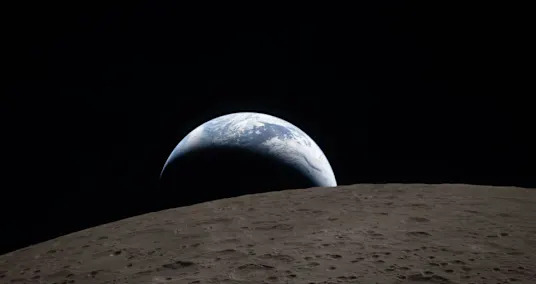
It was a moment for the history books: The Artemis II mission performed its much anticipated lunar flyby yesterday, and came within just 4,067 miles of the moon.
While soaring aboard their Orion capsule beyond the far side of the moon, the crew also reached an estimated 252,756 miles from Earth, breaking Apollo 13’s record for the farthest humans have traveled into space.
The flyby lasted seven hours, during which the astronauts could enjoy views of the lunar surface previously unseen by human eyes, with about 21% of the moon’s mysterious far side illuminated by the sun from the crew’s perspective.
Communications stopped for about 40 minutes during Orion’s transit behind the moon. The crewmembers saw Earth appear to set behind the moon, not dissimilar to what the Apollo astronauts witnessed in 1968. They were also treated to a very special solar eclipse.

After the flyby, Artemis II Commander Reid Wiseman thanked the NASA science team for putting together such an exciting observing program for them, as well as “some great, truly human experience moments here.”
“We were well prepared, and we appreciate all of you, and this is what we do best when we all come together and work as a team,” Wiseman said. “So y’all knocked it out of the park. Thank you for giving us this opportunity.”
Science officer Dr. Kelsey Young shared these comments with the crew: “I can’t say enough how much science we’ve already learned and how much inspiration you’ve provided to our entire team, the lunar science community and the entire world with what you were able to bring today. You really brought the moon closer for us today. And we cannot say thank you enough.”
The crew took thousands of photos that will help inform scientists’ understanding of the moon and its origins — and lay the groundwork for future missions to the lunar surface.
unknown content item
-
“You know from your experience of seeing the Earth from space how it just seems different,” said Canadian Space Agency astronaut Jeremy Hansen, while speaking with NASA Administrator Jared Isaacman about the flyby.
“When we were on the far side of the moon, looking back at Earth, you really felt like you weren’t in a capsule. You’d been transported to the far side of the moon. And it really just bent your mind. It was an extraordinary human experience. We’re so grateful for it.”
For more CNN news and newsletters create an account at CNN.com
LATEST POSTS
- 1
 Addiction-stricken community struggles to keep a syringe program going after Trump's order
 - 2A volcanic eruption may have catalyzed the plague's arrival in Europe, study suggests
- 3'The Beast in Me' arrives on Netflix: Is it based on a true story? And what drew Claire Danes to it? What to know about the thriller series.
- 4Independence from the rat race for Recent college grads: Systems and Tips
- 5Which restaurants and fast food chains will be open on Christmas Eve and Christmas Day?


- ‘Trip of suffering’: Gaza evacuee details 24-hour journey to South Africa
- Man Charged for Stealing ‘Incredibly Precious’ 286-Year-Old Violin, Worth More Than $200,000, from a Tavern
- EU foreign ministers commemorate Russian massacre in Bucha
- Top German court to rule on claims by Wirecard shareholders
- Man triggers smoke bomb during failed crypto robbery
- Italian authorities detain civilian rescue ship, German NGO says
- How to watch Dick Clark’s New Year’s Rockin’ Eve with Ryan Seacrest: Start time, TV channel, performers and more
- 6 Well known Ladies' Fragrances On the planet
- Figure out How to Keep up with Oral Wellbeing During Pregnancy